when you drop a book on the floor what happens to its original potential energy
Learning Objectives
By the terminate of this section, yous will exist able to:
- Explicate gravitational potential free energy in terms of work done against gravity.
- Show that the gravitational potential energy of an object of mass m at height h on World is given by PEg = mgh.
- Show how knowledge of the potential energy as a office of position can be used to simplify calculations and explicate concrete phenomena.
Piece of work Done Against Gravity
Climbing stairs and lifting objects is work in both the scientific and everyday sense—information technology is work washed confronting the gravitational force. When there is work, there is a transformation of energy. The work done against the gravitational force goes into an important class of stored free energy that we will explore in this section.
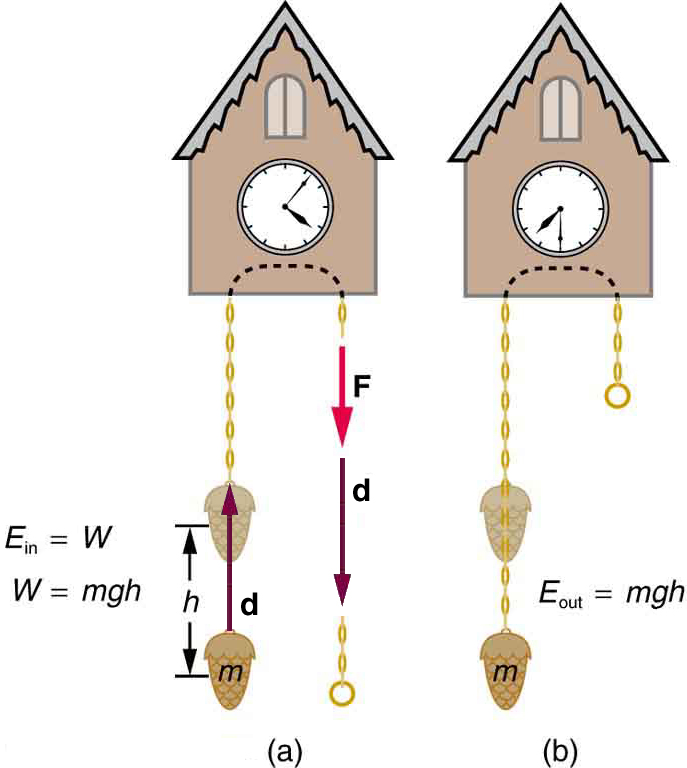
Figure 1. (a) The work done to lift the weight is stored in the mass-Earth system equally gravitational potential energy. (b) As the weight moves downward, this gravitational potential energy is transferred to the cuckoo clock.
Allow usa calculate the work done in lifting an object of mass one thousand through a superlative h, such as in Figure 1. If the object is lifted directly up at constant speed, then the force needed to lift information technology is equal to its weight mg. The piece of work done on the mass is then Westward =Fd =mgh. We define this to be the gravitational potential energy (PEg) put into (or gained by) the object-Earth system. This energy is associated with the state of separation between ii objects that attract each other by the gravitational force. For convenience, we refer to this as the PEthou gained past the object, recognizing that this is energy stored in the gravitational field of Earth. Why exercise we use the word "organization"? Potential energy is a belongings of a system rather than of a unmarried object—due to its physical position. An object'due south gravitational potential is due to its position relative to the surround inside the Globe-object organization. The force practical to the object is an external force, from outside the organization. When it does positive work it increases the gravitational potential energy of the system. Considering gravitational potential energy depends on relative position, we need a reference level at which to set the potential energy equal to 0. We usually choose this point to exist Earth'due south surface, but this bespeak is capricious; what is of import is the difference in gravitational potential energy, because this difference is what relates to the piece of work washed. The difference in gravitational potential energy of an object (in the World-object system) between ii rungs of a ladder will be the same for the beginning 2 rungs as for the final ii rungs.
Converting Between Potential Free energy and Kinetic Energy
Gravitational potential free energy may exist converted to other forms of energy, such equally kinetic energy. If nosotros release the mass, gravitational forcefulness will practise an amount of work equal to mgh on information technology, thereby increasing its kinetic energy past that same amount (past the piece of work-energy theorem). We will find it more useful to consider but the conversion of PEg to KE without explicitly considering the intermediate step of work. (See Case 2.) This shortcut makes it is easier to solve issues using free energy (if possible) rather than explicitly using forces.
More precisely, we ascertain the change in gravitational potential free energy ΔPE1000 to be ΔPEthou =mgh, where, for simplicity, we denote the modify in height by h rather than the usual Δh. Annotation that h is positive when the final peak is greater than the initial height, and vice versa. For example, if a 0.500-kg mass hung from a cuckoo clock is raised 1.00 k, and so its modify in gravitational potential free energy is
[latex]\begin{array}{lll}mgh&=&(0.500\text{ kg})(9.fourscore\text{ m/southward}^2)(ane.00\text{ m})\\\text{ }&=&4.90\text{ kg}\cdot\text{m}^2\text{/s}^2=4.ninety\text{ J}\end{array}\\[/latex]
Notation that the units of gravitational potential energy turn out to be joules, the same as for work and other forms of energy. Every bit the clock runs, the mass is lowered. We tin can call up of the mass as gradually giving up its four.90 J of gravitational potential energy, without direct because the force of gravity that does the piece of work.
Using Potential Energy to Simplify Calculations
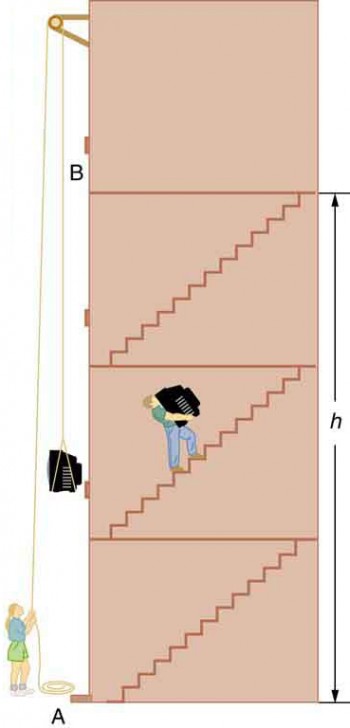
Effigy 2. The change in gravitational potential free energy (ΔPEg) between points A and B is independent of the path.
The equation ΔPEg =mgh applies for whatsoever path that has a change in pinnacle of h, non just when the mass is lifted straight up. (See Figure 2.) Information technology is much easier to calculate mgh (a simple multiplication) than it is to calculate the work washed along a complicated path. The thought of gravitational potential energy has the double advantage that it is very broadly applicative and it makes calculations easier.
From now on, we will consider that any modify in vertical position h of a mass m is accompanied past a change in gravitational potential energy mgh, and we will avoid the equivalent but more difficult job of calculating piece of work done past or confronting the gravitational force.
ΔPEg =mgh for whatever path between the two points. Gravity is one of a small class of forces where the work done by or against the force depends but on the starting and ending points, not on the path between them.
Example ane. The Strength to Terminate Falling
A 60.0-kg person jumps onto the flooring from a height of three.00 m. If he lands stiffly (with his knee joints compressing by 0.500 cm), calculate the force on the knee joints.
Strategy
This person'due south energy is brought to zilch in this situation by the piece of work done on him by the floor as he stops. The initial PEg is transformed into KE equally he falls. The piece of work done by the floor reduces this kinetic energy to zero.
Solution
The work done on the person past the floor as he stops is given pastW =Fd cosθ = −Fd, with a minus sign because the deportation while stopping and the strength from flooring are in opposite directions (cosθ = cos 180º = −1). The floor removes energy from the organisation, then it does negative piece of work.
The kinetic energy the person has upon reaching the floor is the corporeality of potential free energy lost by falling through height h: KE = −ΔPEg = −mgh.
The altitude d that the person's knees curve is much smaller than the height h of the fall, then the boosted change in gravitational potential energy during the human knee bend is ignored.
The work W done by the floor on the person stops the person and brings the person'due south kinetic energy to zero:W = −KE =mgh.
Combining this equation with the expression for W gives −Fd =mgh.
Recalling that h is negative considering the person barbarous downwards, the forcefulness on the articulatio genus joints is given by
[latex]\displaystyle{F}=-\frac{mgh}{d}=-\frac{\left(60.0\text{ kg}\right)\left(9.80\text{ grand/s}^2\right)\left(-3.00\text{ k}\right)}{5.00\times10^{-3}\text{ grand}}=3.53\times10^v\text{ N}\\[/latex]
Give-and-take
Such a big force (500 times more than than the person'south weight) over the short impact time is enough to break bones. A much amend way to absorber the shock is past angle the legs or rolling on the ground, increasing the time over which the forcefulness acts. A bending motility of 0.five m this way yields a forcefulness 100 times smaller than in the example. A kangaroo's hopping shows this method in action. The kangaroo is the simply big animal to use hopping for locomotion, but the shock in hopping is cushioned by the bending of its hind legs in each leap. (Run across Effigy 3.)
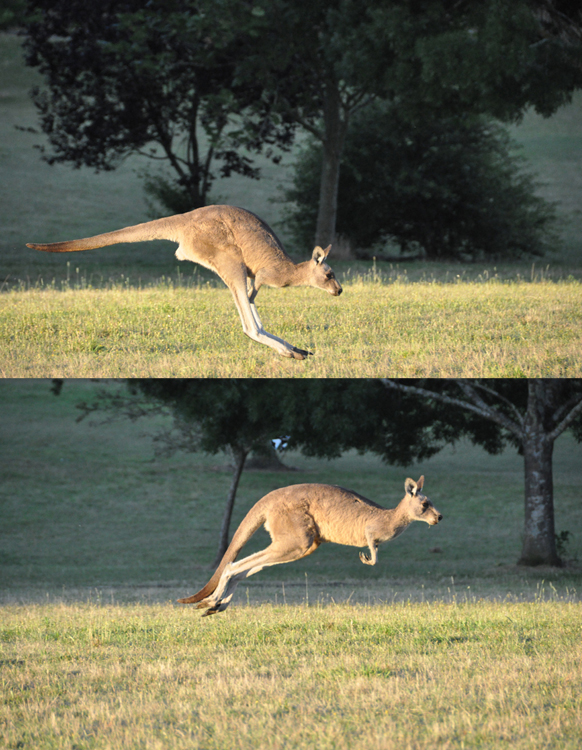
Figure 3. The piece of work washed past the ground upon the kangaroo reduces its kinetic energy to nothing as it lands. Notwithstanding, by applying the strength of the ground on the hind legs over a longer distance, the affect on the basic is reduced. (credit: Chris Samuel, Flickr)
Example 2. Finding the Speed of a Roller Coaster from its Peak
- What is the concluding speed of the roller coaster shown in Figure 4 if it starts from rest at the top of the xx.0 m hill and piece of work done by frictional forces is negligible?
- What is its final speed (over again bold negligible friction) if its initial speed is 5.00 grand/s?
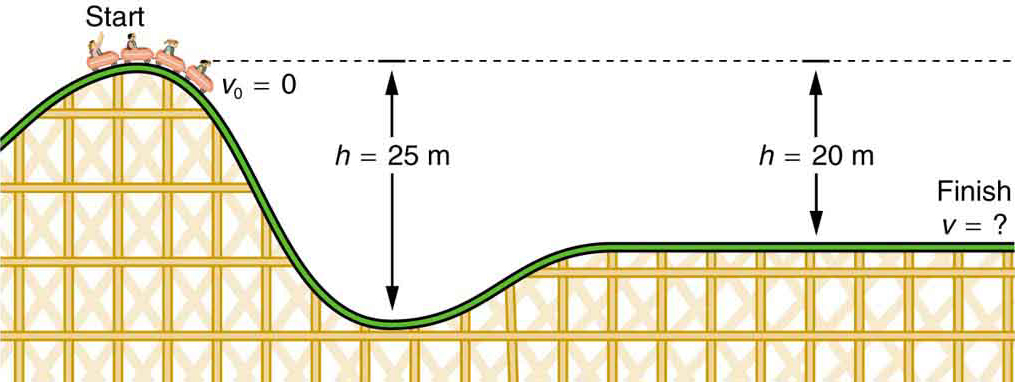
Effigy four. The speed of a roller coaster increases every bit gravity pulls it downhill and is greatest at its lowest point. Viewed in terms of energy, the roller-coaster-Earth arrangement's gravitational potential energy is converted to kinetic free energy. If work done by friction is negligible, all ΔPEg is converted to KE.
Strategy
The roller coaster loses potential energy as it goes downhill. We neglect friction, and so that the remaining force exerted past the rail is the normal force, which is perpendicular to the direction of move and does no piece of work. The net work on the roller coaster is then done by gravity alone. The loss of gravitational potential free energy from moving down through a distance h equals the gain in kinetic energy. This can exist written in equation form equally −ΔPEg= ΔKE. Using the equations for PEthou and KE, nosotros tin solve for the last speed 5, which is the desired quantity.
Solution for Function 1
Hither the initial kinetic energy is zip, and so that [latex]\Delta\text{KE}=\frac{1}{2}mv^2\\[/latex]. The equation for change in potential energy states that ΔPEg =mgh. Since h is negative in this case, we will rewrite this as ΔPEg = −mg|h| to show the minus sign clearly. Thus, −ΔPEchiliad= ΔKE becomes [latex]mg|h|=\frac{one}{2}{mv}^2\\[/latex].
Solving for v, we notice that mass cancels and that [latex]five=\sqrt{2g|h|}\\[/latex].
Substituting known values,
[latex]\brainstorm{array}{lll}v&=&\sqrt{2\left(ix.80\text{ m/due south}^2\right)\left(20.0\text{ one thousand}\right)}\\\text{ }&=&19.viii\text{ m/southward}\end{array}\\[/latex]
Solution for Part 2
Once again −ΔPEg = ΔKE. In this case there is initial kinetic energy, so
[latex]\Delta\text{KE}=\frac{1}{2}mv^2-\frac{1}{2}mv_0^two\\[/latex].
Thus, [latex]mg|h|=\frac{1}{2}mv^2-\frac{i}{2}mv_0^ii\\[/latex].
Rearranging gives [latex]\frac{i}{two}mv^2=mg|h|+\frac{one}{2}mv+0^2\\[/latex].
This means that the final kinetic energy is the sum of the initial kinetic energy and the gravitational potential energy. Mass again cancels, and [latex]5=\sqrt{2g|h|+v_0^2}\\[/latex].
This equation is very like to the kinematics equation [latex]v=\sqrt{v_0^2+2ad}\\[/latex], only it is more than general—the kinematics equation is valid only for constant acceleration, whereas our equation higher up is valid for any path regardless of whether the object moves with a constant acceleration. Now, substituting known values gives
[latex]\begin{array}{lll}5&=&\sqrt{ii\left(9.80\text{ m/s}^two\correct)\left(20.0\text{ m}\right)+\left(five.00\text{ k/southward}\right)^two}\\\text{ }&=&20.4\text{ thousand/s}\terminate{assortment}\\[/latex]
Discussion and Implications
First, note that mass cancels. This is quite consistent with observations made in Falling Objects that all objects autumn at the same rate if friction is negligible. Second, only the speed of the roller coaster is considered; there is no information virtually its management at whatever point. This reveals another general truth. When friction is negligible, the speed of a falling body depends simply on its initial speed and height, and not on its mass or the path taken. For example, the roller coaster volition have the aforementioned final speed whether information technology falls twenty.0 g straight down or takes a more complicated path like the one in the figure. 3rd, and perhaps unexpectedly, the final speed in part 2 is greater than in part 1, but by far less than 5.00 m/south. Finally, annotation that speed can exist found at any height along the way past simply using the appropriate value of h at the point of involvement.
We take seen that work done by or against the gravitational forcefulness depends just on the starting and catastrophe points, and not on the path betwixt, assuasive us to ascertain the simplifying concept of gravitational potential energy. We can practice the same matter for a few other forces, and we will come across that this leads to a formal definition of the law of conservation of energy.
Making Connections: Take-Home Investigation—Converting Potential to Kinetic Energy
One tin study the conversion of gravitational potential free energy into kinetic energy in this experiment. On a smooth, level surface, use a ruler of the kind that has a groove running along its length and a book to make an incline (run into Figure v). Identify a marble at the 10-cm position on the ruler and let it roll downwardly the ruler. When it hits the level surface, measure out the fourth dimension information technology takes to roll one meter. Now place the marble at the 20-cm and the xxx-cm positions and once again mensurate the times it takes to roll 1 thousand on the level surface. Find the velocity of the marble on the level surface for all three positions. Plot velocity squared versus the distance traveled by the marble. What is the shape of each plot? If the shape is a direct line, the plot shows that the marble'south kinetic energy at the bottom is proportional to its potential energy at the release signal.
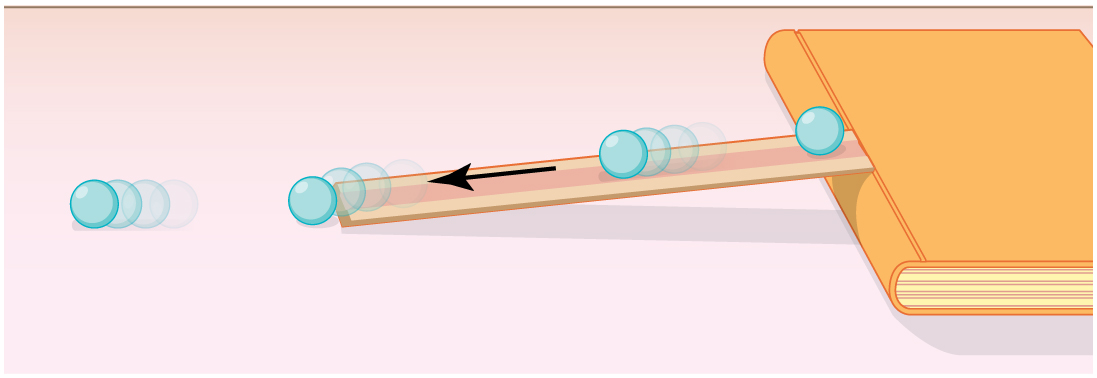
Effigy 5. A marble rolls downwards a ruler, and its speed on the level surface is measured.
Section Summary
- Work done confronting gravity in lifting an object becomes potential energy of the object-Globe system.
- The change in gravitational potential energy, ΔPEg, is ΔPEthousand = mgh, with h being the increase in height and m the acceleration due to gravity.
- The gravitational potential energy of an object near Earth'due south surface is due to its position in the mass-Globe system. Merely differences in gravitational potential energy, ΔPEg, have physical significance.
- Equally an object descends without friction, its gravitational potential energy changes into kinetic free energy corresponding to increasing speed, so that ΔKE = −ΔPEg
Conceptual Questions
- In Instance 2, we calculated the final speed of a roller coaster that descended 20 thou in height and had an initial speed of 5 m/south downhill. Suppose the roller coaster had had an initial speed of 5 yard/south uphill instead, and it coasted uphill, stopped, and and then rolled back downwards to a final point 20 m below the outset. We would find in that case that it had the aforementioned final speed. Explain in terms of conservation of free energy.
- Does the piece of work you exercise on a book when you lift it onto a shelf depend on the path taken? On the time taken? On the height of the shelf? On the mass of the book?
Problems & Exercises
- A hydroelectric ability facility (encounter Effigy 6) converts the gravitational potential energy of water behind a dam to electric energy. (a) What is the gravitational potential energy relative to the generators of a lake of volume 50.0 km3 (mass = 5.00 × x13 kg), given that the lake has an average height of 40.0 k above the generators? (b) Compare this with the energy stored in a 9-megaton fusion bomb.
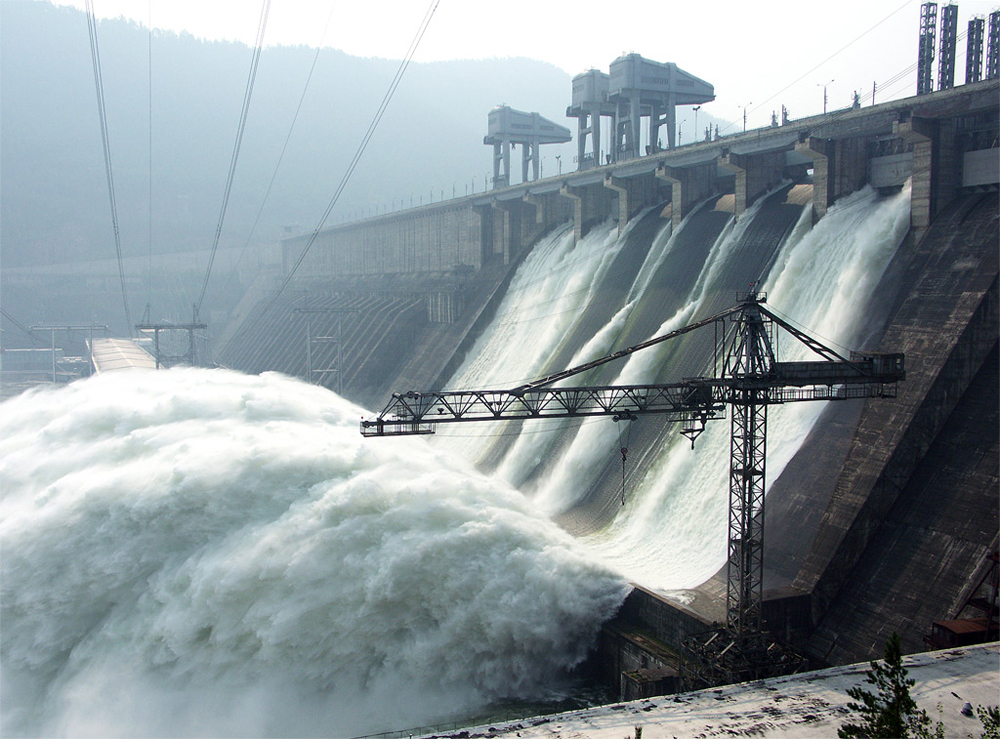
Figure 6. Hydroelectric facility (credit: Denis Belevich, Wikimedia Commons)
- (a) How much gravitational potential free energy (relative to the ground on which it is built) is stored in the Great Pyramid of Cheops, given that its mass is about vii × 109 kg and its heart of mass is 36.5 m in a higher place the surrounding footing? (b) How does this energy compare with the daily food intake of a person?
- Suppose a 350-g kookaburra (a big kingfisher bird) picks upwardly a 75-g snake and raises information technology 2.5 m from the ground to a branch. (a) How much work did the bird do on the ophidian? (b) How much piece of work did it do to raise its ain center of mass to the branch?
- In Example 2, nosotros found that the speed of a roller coaster that had descended 20.0 m was only slightly greater when it had an initial speed of 5.00 m/s than when information technology started from residual. This implies that ΔPE >> KEi. Confirm this statement by taking the ratio of ΔPE to KEi. (Note that mass cancels.)
- A 100-k toy automobile is propelled by a compressed bound that starts it moving. The motorcar follows the curved track in Effigy vii. Show that the final speed of the toy car is 0.687 m/due south if its initial speed is 2.00 m/southward and it coasts up the frictionless slope, gaining 0.180 grand in altitude.
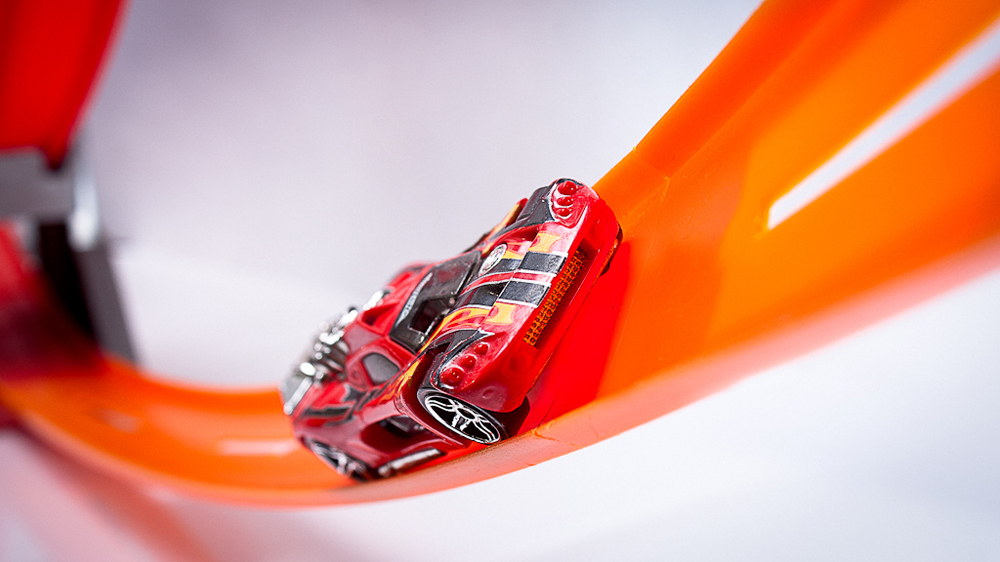
Figure 7. A toy car moves up a sloped rails. (credit: Leszek Leszczynski, Flickr)
- In a downhill ski race, surprisingly, picayune advantage is gained past getting a running start. (This is because the initial kinetic energy is minor compared with the gain in gravitational potential energy on even small-scale hills.) To demonstrate this, find the final speed and the time taken for a skier who skies 70.0 m along a 30º slope neglecting friction: (a) Starting from rest. (b) Starting with an initial speed of 2.50 thousand/south. (c) Does the reply surprise you? Talk over why it is withal advantageous to get a running start in very competitive events.
Glossary
gravitational potential energy: the energy an object has due to its position in a gravitational field
Selected Solutions to Bug & Exercises
1. (a) one.96 × 1016 J; (b) The ratio of gravitational potential energy in the lake to the energy stored in the bomb is 0.52. That is, the energy stored in the lake is approximately half that in a 9-megaton fusion flop.
iii. (a) i.8 J; (b) viii.half-dozen J
5. [latex]{five}_{f}=\sqrt{2gh+{v_0}^2}=\sqrt{2\left(9.fourscore\text{ 1000/south}^two\right)\left(-0.180\text{ yard}\correct)+\left(2.00\text{ 1000/s}\right)^2}=0.687\text{ thou/s}\\[/latex]
Source: https://courses.lumenlearning.com/physics/chapter/7-3-gravitational-potential-energy/
0 Response to "when you drop a book on the floor what happens to its original potential energy"
Postar um comentário